
How To Read A Paternity DNA Test Result?
How To Read A Paternity Test Result?
We recommend starting at the bottom of the report in the conclusion section of your DNA result. Everything above the conclusion serves as supporting data. The laboratory utilizes these alleles/genetic marker comparisons to reach the conclusion shown at the bottom of the result.
There are three possible outcomes listed below:
- Inclusion – Means the probability of paternity supports the man tested as the alleged father cannot be excluded as the biological father of the child.
- Exclusion – Means the tested man is excluded as the biological father of the tested child.
- Inconclusive – Inconclusive outcomes are rare. The laboratory reaches this outcome when the lab cannot conclusively or definitively determine whether the alleged father and the child are biologically related. The mother oftentimes may not have been tested in these cases. The lab will request the mother’s sample if available to reach a definitive result when an inconclusive outcome occurs.
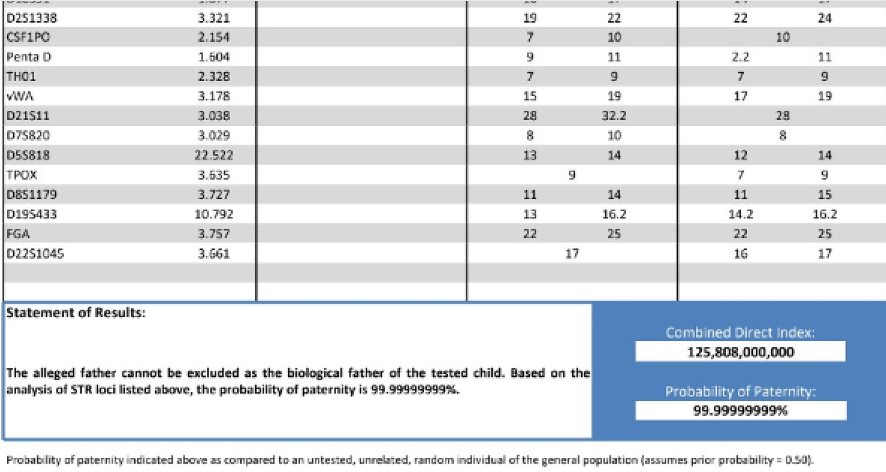
What does “99.99% probability of paternity” mean?
A DNA paternity test result showing a probability of paternity of 99.99% or higher strongly supports that the tested man is the biological father of the tested child. The laboratory will typically report that the alleged father cannot be excluded as the biological father.
This result does not mean there is a 0.01% chance that someone else is the father, a distinction that can be misleading reading your results.
The probability does not reach 100% because the calculation is statistical. The tested man’s genetic evidence is compared against the probability that a random, unrelated man from the relevant population could produce the observed genetic evidence.
What does “excluded as the biological father” mean
A 0% probability of paternity indicates that the tested man is excluded as the biological father of the tested child. Exclusions are a statement of fact; they are not a statistical estimation. Exclusions are based on each genetic marker tested. They involve multiple different markers that do not match from the father to the child.
What does the probability of paternity mean?
The probability of paternity is a statistical calculation comparing one tested man against the general population.
This calculation answers the question: how much more likely is it that the tested man is the father of a child than a random untested man from the same population group? The conclusion represents the comparative analysis of each genetic marker on your report. This analysis identifies the biological markers shared by both the tested man and the child.
What is the Combined Paternity Index (CPI)?
The Combined Paternity Index (CPI) is a ratio rather than a percentage. This ratio indicates how many times more likely the tested man is to be the biological father compared to a random untested man in the same population group. A CPI of 100,000 means the genetic evidence favors the tested man 100,000 to one. The probability of paternity calculation reflects the CPI ratio, such as 99.99% or 99.9999% and higher.
What does an allele or STR marker mean on my DNA results?
The laboratory compares the child’s alleles with the alleged father’s alleles across the tested STR loci to determine whether the alleged father can be excluded and, when he is not excluded, to calculate the statistical evidence supporting paternity.
An STR (Short Tandem Repeat) locus is a specific location in DNA examined during paternity testing. The numbers shown at each locus are called alleles. A child inherits one allele from the biological mother and one from the biological father at each tested location.
| STR Marker | Child | Alleged Father | Interpretation |
|---|---|---|---|
| D8S1179 | 10, 15 | 10, 12 | Shared allele: 10 |
| D21S11 | 28, 30 | 30, 31 | Shared allele: 30 |
A shared allele at an individual STR marker does not determine paternity by itself. The laboratory evaluates the STR markers collectively to determine whether the alleged father is excluded or to calculate the statistical evidence supporting paternity.