
Immigration DNA Testing
Prices Start at $575.00
Trusted By Legal & Medical Professionals Since 2010
Partner AABB Accredited Lab Analysis
Discreet and Confidential
We Do not sell your information
Real Support
Assigned DNA Caseworker
An immigration DNA test is a relationship test that helps petitioners prove a claimed biological relationship to USCIS or the U.S. Embassy when the primary evidence submitted during the visa application process is insufficient. It is important to note that DNA testing for immigration purposes is voluntary and not mandatory.
How much does an immigration DNA test cost?
Pricing starts at $575.00. Sample collection fees are not included in the cost of your DNA test. Click to see below are the immigration DNA testing services we provide for immigration evidence submission cases.
Is immigration DNA Testing a requirement?
No. Immigration DNA Testing a secondary voluntary/suggested option to help petitioners confirm the claimed biological relationship with the beneficiary.
DNA testing may be suggested when insufficient primary evidence is submitted to USCIS during the U.S. visa application filing process.
Family Relationship DNA Testing Options
| Service Type | Pricing |
| Immigration Paternity Test: This testing option determines whether a father is biologically related to a child. | Prices start at $575.00 CALL FOR APPOINTMENTS |
| Maternity Testing: This testing option determines whether a mother is biologically related to her child. | Prices start at $575.00 CALL FOR APPOINTMENTS |
| Sibling DNA Testing: This testing option determines if two or more alleged siblings share a common biological parent. | Prices start at $695.00 CALL FOR APPOINTMENTS |
| Grandparent DNA Testing: This testing option helps to determine whether a grandparent is biologically related to a grandchild | Prices start at $695.00 CALL FOR APPOINTMENTS |
Please note, Immigration DNA testing should be performed when prompted or given the opportunity by a state or government agency, not before. If you’re considering performing a DNA test, we recommend that you speak with one of our DNA testing consultants regarding your specific circumstance. If you are uncertain whether to perform a DNA test prior to receiving any documentation from an immigration office.
How to Get a DNA Test for Immigration?
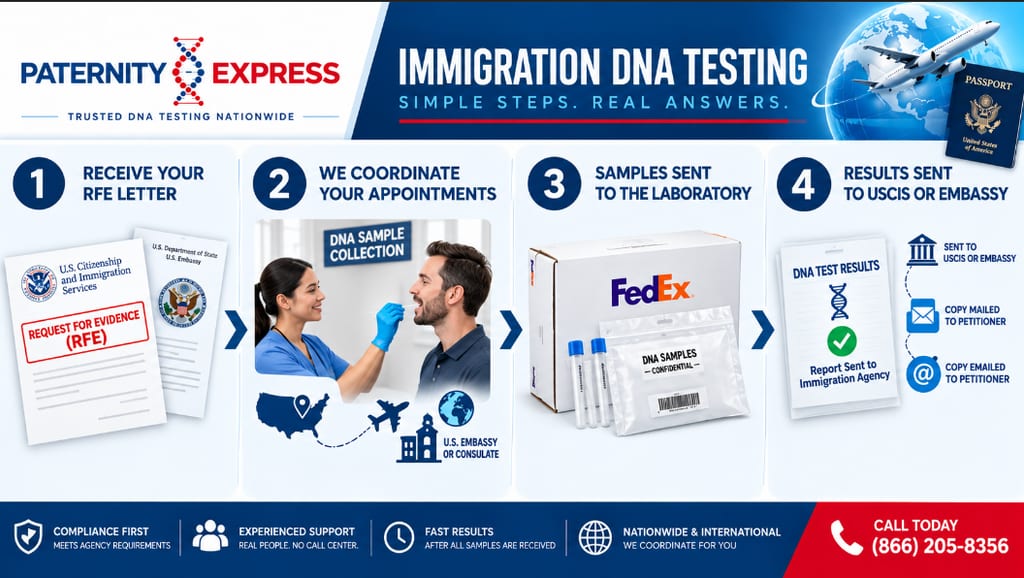
Getting started is simple. Below is a brief overview of what to expect from our immigration testing process.
- Once you receive your request for evidence letter from either a USCIS agency or from a U.S. Embassy requesting your family to submit additional secondary evidence, you can contact our office at (866) 205-8356 to schedule a case initiation and appointment.
- After your case has been initiated by our partner, AABB Accredited Laboratory, your DNA sample collection appointment for the petitioner located in the U.S. will be scheduled and coordinated for all parties located here in the United States. If the beneficiary lives abroad, after the petitioner’s DNA sample is collected, the laboratory will be responsible for sending the DNA test kit to the embassy or consulate in the beneficiary’s country.
- Once the petitioner samples have been collected, they will be sent to the laboratory awaiting the beneficiary’s DNA samples to arrive. A comparative analysis can be performed with all participants’ DNA profiles.
- Once the laboratory receives all DNA samples and testing and analysis are completed, a copy of the results will be sent to the requesting immigration agency, and then an additional copy will be sent to the petitioner by mail, and another copy will be sent by email for your records.
It is important to note that petitioners who reside in the United States, once your sample is collected, the sample will be sent to the laboratory where your sample will be stored. There will not be a separate DNA result for you and then, when the beneficiary samples arrive from abroad, a secondary result for the beneficiary. In order for a result to be produced, comparative analysis between petitioner and beneficiary is required.
What Is the Difference Between USCIS and U.S. Embassy DNA Testing Requests?
The main difference between USCIS and U.S. Embassy DNA testing requests is the government agency handling the case and where the case is in the immigration process.
USCIS DNA Testing
A USCIS DNA testing request may occur when USCIS issues a Request for Evidence (RFE) asking a petitioner to provide additional evidence to establish a claimed biological relationship. DNA testing may be submitted as secondary evidence when other documentation is insufficient or inconclusive.
DNA testing is voluntary. Petitioners should carefully review their USCIS notice to understand what evidence has been requested and whether other forms of supporting documentation may be submitted.
U.S. Embassy DNA Testing
A U.S. Embassy or Consulate DNA testing request may occur when a consular officer suggests DNA testing to establish a claimed biological relationship when other evidence is insufficient. These requests may involve an immigrant visa, U.S. passport, or Consular Report of Birth Abroad (CRBA) case.
DNA testing is voluntary. When an overseas DNA collection is required, the testing process must follow the collection procedures provided by the U.S. Embassy or Consulate.
The Main Difference
USCIS cases are handled through U.S. Citizenship and Immigration Services, while U.S. Embassy and Consulate cases are handled through the Department of State.
A USCIS case may involve participants located entirely within the United States or participants located in different countries. Embassy and Consulate DNA cases generally involve at least one participant who requires DNA sample collection abroad.
In either situation, the DNA testing process must follow the requirements of the government agency handling the case.
Where can I get a DNA test for immigration?
Call 866-205-8356 to speak with a DNA consultant to get started. Below are the areas we serve nationwide.
Alabama
Alaska
Arizona
Arkansas
California
Colorado
Connecticut
Delaware
Florida
Georgia
Hawaii
Idaho
Illinois
Indiana
Iowa
Kansas
Kentucky
Louisiana
Maine
Maryland
Massachusetts
Michigan
Minnesota
Mississippi
Missouri
Montana
Nebraska
Nevada
New Hampshire
New Jersey
New Mexico
North Carolina
North Dakota
Ohio
Oklahoma
Oregon
Pennsylvania
Rhode Island
South Carolina
South Dakota
Tennessee
Texas
Utah
Vermont
Virginia
Washington
West Virginia
Wisconsin
Wyoming
Please note, we provide international immigration DNA testing services worldwide. Contact our office at 866-205-8356 to inquire about immigration DNA testing for your country.
Frequently Asked Immigration Questions
What is the method of DNA sample collection for immigration DNA testing?
The industry standard method of sample collection is performed by sterilized cheek swab. Although blood is a viable collection method, both options have the same accuracy, but the blood collection option is more expensive and painfully invasive.
How long does it take to receive my DNA results?
The average turnaround time can range from 3 days for domestic DNA testing. International DNA tests the average turnaround time of 6 to 8 weeks is sometimes longer depending on the embassy or consulate’s workload.
Does an immigration DNA test guarantee visa approval?
No. Immigration DNA test results are secondary evidence that can voluntarily be used to help prove a claimed biological relationship. U.S. visa issuance is determined by the requesting immigration agency.
Can I take the test before receiving a request?
No. We do not recommend performing a DNA test for immigration evidence submission before receiving an official request. Submitting DNA evidence before receiving an RFE may not follow the requesting immigration agency’s evidence submission procedures.
Performing a DNA test prematurely may result in having to complete and pay for another DNA test after you receive the official request.
Can an at-home DNA test be used for immigration?
No. At-Home DNA Testing process does not meet the evidence submission guidelines for immigration purposes.